

This afternoon we were contacted by the local newspaper to help identify a strange looking owl that had been spotted locally, and also asked for some information on the day-time habits of our feathered friends..
A reader had sent some pictures to the East Anglian Daily Times, and they posed quite a puzzle. To be honest - we were undecided: at first glance the subject looked like a Bengal Eagle Owl - a desert dweller if ever there was one, and therefore (unless it was an escaped captive bird) way off it's normal beat - or, it was a long eared owl, much more likely because the species is a native of these isles (though in itself quite a rare siting as these birds are notoriously shy). Both species are quite similar in size. What do you think? Click here to e-mail us your opinion.
On the question of an owl being seen in the daytime, it is not unusual to see Owls during the day during the winter months as the trees are bare and the owl does not have the same cover to hide as it normally would in the summer. It is a common misconseption that all owls are purely nocturnal, but many species native to the British Isles are "crupuscular", which means they will hunt mainly in the low light at dusk and dawn.
Long Eared Owls hunt mainly on open range land - clearings, fallow fields and river banks - rather than the woodlands where they roost and nest, which is usually in old un-ocupied stick nests belonging to crows, magpies, ravens or herons.
Maz. Robinson
Oh What A Picture!
This week's BBC Countryfile programme featured an interesting story about farmer & amateur photographer Ed Frear, who produced this stunning and slightly surreal image of Barn Owls taken on his Cambridgeshire farm.

The picture was selected by comedienne Jo Brand as one of the images for the Countryfile 2008 Calendar, which has been produced in aid of Children In Need appeal. Ed bought his digital camera two years ago, although little did he know it would lead to a passion for wildlife photography. By converting a shabby chicken coop into a bird hide and waiting patiently on his stomach in the mud for hours on end, he eventually managed to capture the amazing photograph of the three barn owl chicks sitting in the window of one of his old barns.

The calendar itself costs £9 including p&p. To order a copy, call the order line on 0870 062 3600 (Calls cost 6p from a BT landline. Mobiles and other networks may vary) or send a cheque to: BBC Countryfile Calendar, PO Box 25, Melton Mowbray, Leicestershire, LE13 1ZG (Don't forget to give your name and address and please make cheques payable to BBC Countryfile Calendar)
Bird Flu Outbreak On Our Doorstep
This week Suffolk Owl Sanctuary has found itself near to the eye of a national storm as avian influenza has been found on the Suffolk/Norfolk border, virtually on our doorstep. We thought you might like to know how will it affect us.
At the beginning of the week, DEFRA confirmed an outbreak of deadly H5N1 form of "bird flu" virus at Redgrave Park Farm, a free-range poultry farm about 15 miles north of us.
Fred Landeg, the acting Chief Veterinary Officer, confirmed the strain - which has swept across Asia, Europe and Africa since 2003 - is potentially dangerous to humans and added: "The initial sequence data suggests that the outbreak is closely related to outbreaks in the Czech Republic and Germany, which indicates a possible wild bird source. However, at this stage all potential sources of the origin will be investigated."
The Environment Minister Hilary Benn briefed MPs on the outbreak, warning them more cases could be discovered in the area. A cull of all 5,000 poultry at the infected farm has been completed and the cull of a further 22,000 birds at other farms operated by the same company has begun. A 3km protection zone and 10km surveillance zone were set up yesterday around the area
All free-range birds for meat and eggs in Suffolk and part of Norfolk must be locked indoors to protect them from the spread of the virus. Hobby farmers with backyard flocks are also being visited by local animal health officers who are urging them to keep birds inside.
Bird viruses do not usually infect humans but some people who have been in close contact with infected birds have died. Scientists are worried that avian flu will mutate and spread from person to person, infecting larger numbers of people.
But Veterinary Office Landeg said people should not be worried about contracting the human form of the virus: "This particular strain of virus has on rare occasions passed to human beings, particularly in the Far East, where poultry workers have had very close contact with sick and diseased birds. The general public needn't worry about contact with the birds. Spread to humans is not very common and no human has contracted the disease in Western Europe."
So how will the bird flue outbreak affect us here at SOS? For the moment, we are following DEFRA Guidelines and placing disinfectant foot-baths at all out entrances and exits for our visitors to use in the hope that it will significantly reduce the possibility of our bird collection becoming infected.
We have also cancelled all out-shows and are not moving birds or accepting wild injured birds into the centre as recommended by DEFRA until advised that it is safe so-to-do.
Other than that, we are remain vigilant of the threat and will continue to operate as normal here at SOS.

Steve Round's stunning photo of the equally stunning Hen Harrier
Case closed due to "Lack of Evidence"
In our last blog we gave you the news of the two Hen Harriers shot dead at Dresingham Bog, close to the Sandringham estate in Norfolk and we said we would keep you up dated with any further developments in the case.
Sadly, the same story has hit the news again this week, but for a very different reason! It now seems that there is a "lack of evidence" to pursue that matter further which is terribly disappointing for both conservationists and raptor enthusiasts.
The news has also been greeted with grave disappointment by the RSPB. Commenting on the official statement released by the Crown Prosecution Service, the RSPB's Conservation Director Dr Mark Avery said: 'We regard the killing of Hen Harriers as one of the most serious of wildlife crime offenses. We would always hope that people killing Hen Harriers be brought to justice (and that) their illegal killing is the reason for this bird's low UK population, especially in England where only 20 pairs remain.'
Continuing, he said: 'Despite a thorough and swift investigation by the Norfolk Constabulary, the RSPB is disappointed there is insufficient evidence to proceed with the investigation. However, we don't want the death of these two harriers to be completely in vain. At a time when the one-year old National Wildlife Crime Unit faces a funding crisis and police forces are abolishing dedicated wildlife crime investigation posts, we would like assurances that the investigation of wildlife crime offenses will be fully investigated. Operation Artemis - the police operation to protect the Hen Harrier - needs to be properly resourced, tasked and supported by police and Natural England.
If you feel as strongly as we do at S.O.S. about this tragedy and the lack of funding to protect all our native wildlife, then why not post us a comment voicing your opinion and we will see that it is delivered to the relevant officials.
If you would like to know more about this story from an 'insiders' point of view, then why not click on these links to discover more!
Mark Thomas, Investigations Officer, has written about the RSPB's involvement in the case and you can also watch a video comment from Mark Avery about the recent events at Sandringham.

A rare shot of a male Hen Harrier swooping to feed its young
Hen Harrier Shooting Tragedy
The protection and conservation of raptor species is now very much a global concern, and if you read our last blog entry you will see that we brought news of the dreadful killing of 52 Red-footed falcons as they migrated over Cyprus last month.
Sadly, this type of mindless killing can also be found closer to home - here in the UK.
Many of the UK's leading newspapers recently ran a story about the killing of two Hen Harriers, which were found shot dead at Dresingham Bog, close to the Sandringham Estate. The story hit the headlines because Prince Harry was believed to have been shooting in the area at the time.
Hen harriers are the country's most persecuted bird of prey and are often shot by gamekeepers because they feed on game birds such as pheasants and grouse being reared for shoots, says the RSPB.
Hen harriers are rare in England where it is estimated that there are only 20 breeding pairs. They are legally protected and the killing of one carries a six-month jail sentence or a £5,000 fine. An RSPB spokesman said: "The population should be ten times higher than it is."
Norfolk police are continuing their investigation, and we will of course keep you updated with any further developments regarding this story.
For the full story by Andy McSmith, go to www.environment.independant.co.uk/nature/article3115529.ece

The beautiful Red Footed Falcon - needlessly slaughtered in Cyprus
Conservation Has No Boundaries
Here at SOS, we like to take an active role in the conservation and rehabilitation of many different bird of prey species and if you read our diary pages on a regular basis, you may know something of the various rehab events we have been involved with in recent months.
We also like to be aware of what is happening elsewhere and I thought I would take this opportunity to tell you of recent events in Scotland, when conservationists met to discuss the many problems facing raptors in the wild across Europe.
Conservationists from 60 countries attempted to reach an agreement on the best way to protect birds of prey. Recent research shows that many species are especially vulnerable during migration and would benefit from increased protection while crossing international boundaries. As top predators, birds of prey are sensitive indicators of the condition of the environments they pass through - for instance, how changes in the global climate which can affect wildlife and people.
Michael Russell, Minister for Environment for Scotland, welcomed the delegates by saying: "Scotland is home to the majority of raptors within the UK and I look forward to the development of a new international agreement aimed at conserving migratory birds of prey and owls in Africa and Eurasia.
"Dr Mark Avery, the RSPB's Director of Conservation added: "In the UK, illegal persecution of birds of prey remains a continual threat affecting the future of many species, such as the golden eagle and hen harrier.
"A variety of human-induced threats are driving declines in migratory birds of prey - for instance, habitat loss & degradation, and electrocution by power lines. Climate change is a further concern, and so is direct persecution in the form of illegal shooting and poisoning.
To highlight this latter point, the RSPB's BirdLife International partners in Cyprus and Malta have between them recorded several incidents of bird of prey persecution in recent weeks, the worst incident being the slaughter of over 50 red-footed falcons migrating across Cyprus.
The UK's Biodiversity Minister Joan Ruddock said: "There is no doubt these magnificent birds are under serious threat... and (our) commitment to their conservation is clear. The Government has brought together experts from around the world to develop an agreement for their conservation.
"Commenting ahead of the conference, the RSPB's delegate John O'Sullivan, said:"For those birds of prey that migrate across international boundaries, it's vital that protection and conservation measures are of a high standard in each country, and are well enforced.
"The agreement is expected to be finalised at a meeting in the United Arab Emirates sometime next year. For more information go to www.rspb.org.uk

Cedar the Harris' Hawk from S.O.S. took to the skies at the opening
Lasting First Impressions
Earlier in the year, SOS were asked to help with the launch of a new school logo - you may remember the story called “Minerva’s Eye” from September 14th.
The school logo launch was a very interesting project to be involved with, because it was based upon the eye of Minerva’s Owl (with a lot of Roman history involved) and because of the historical Owlery connection, the school asked a representative of S.O.S. to attend the logo launch with one of our feathered friends!
On that occasion Baloo, our young Bengal Eagle Owl, was drafted in to make a guest appearance and very popular he proved to be, too. Meanwhile we were impressed by just how many questions the children had to ask about owls as a result of seeing Baloo in the flesh, but sadly on that occasion the 'paparazzi' called in the event and Baloo was whisked away to do the all important ‘photo-shoot’ for the local press.
What was clear, however, was that the children were clearly fascinated by raptors and for us, it felt really good too establish a strong bond with such a prominent local school. As a follow-up, we're pleased to say that - having apparently made a lasting "first" impression - we were flattered to be asked back to Ipswich High School for Girls to help with yet another launch! Head of the School, Elaine Purves and Head of the Nursery School, Jane Pomeroy, wanted us to help with the launch of their new WOODLAND NURSERY, which is located within the school grounds.
We were invited to the ceremony in a symbolic capacity, signifying the launch of the nursery by "launching" one of our fabulous birds into the air. On this occasion it was Cedar the Harris Hawk who thrilled the crowds with his ariel dexterity.
That said, as magnificent as Harris’ Hawks are, they don’t have the appropriate tools for the requisite cutting of the ceremonial green ribbon which opened the Woodland Nursery, so a suitable local celebrity - Jimmy Doherty of TV's "Jimmy's Farm" fame, was drafted in to perform the honours. It was very nice to meet Mr. Doherty in person and it was a lovely gesture he made to the school by giving up his time to publicize the launch.

Jimmy Doherty of TV's "Jimmy's Farm" fame opened the new project
The reason we were particularly pleased to be involved was because this pre-school focuses heavily on 'green' issues especially concerning respect for the countryside, and it does so in a way that very young children will understand and appreciate, much evidence of which can be seen in much of the artwork adorning the classroom walls of the school - an example of which you can see pictured here. So, congratulation to Ipswich High School for Girls for all their educational efforts regarding environmental issues, and long may it continue!

The pupils show plenty of concern for 'green' issues in their decorative classroom artworks
PLEASE NOTE: If you know of a local school in East Anglia who deserve a special mention for their environmental/ conservational Activities, why not drop us a line and we will be happy to write a post about them on our website. Likewise, if you know a local school or youth group who could benefit from an SOS Educational visit, then please let us know!
Taiga, Taiga, Burning Brighter ...
Taiga, Taiga, Burning Brighter ...and yes this is the correct spelling!
Regular readers of the S.O.S. Blog will remember the story of Taiga's arrival at the end of the summer, writes our Warden, Juli Finnis.. (Those of you new to the Blog can look back at the previous story dated 6th September)
Today (Saturday 13th October) Taiga went solo - that is, he had his maiden free flight.
He is certainly going to be a huge star in the future. He has been a delight to train and has taken to the air like a true professional. Training begins with him getting used to the falconer's glove being his dinner plate. Once he feels happy and secure we ask him to step up to the glove to collect his food and then to jump about a foot for it. The next stage is to attach a training line which has a fancy french name. It's called a 'creance' and is 25m of light-weight nylon line attached to a weighted wooden stick at one end. The free end can then be tied to the swivel at the end of the bird's leather jesses. This allows you to gradually increase the distance the bird has to travel to collect his meal whilst still being able to prevent him taking to the skies and disappearing over the horizon. Once he is responding immediately to the food on the glove at the full length of the creance line it is time to remove the line and let him fly free.

Taiga has taken the short route to free flight. His first day on a creance line was thursday. After a couple of false starts where he wobbled on the edge of the fence like a tight rope walker trying to keep his balance he summoned up the courage to let go of the fence and fly to the glove - unfortunately, he misjudged the distance and flew six foot above my head before returning to the fence. However, he quickly got the hang of the whole process and by yesterday was quite happily flying the full length of the line. (With some birds this might take a week with increasing the distance just a little each day). So today was his big day and not only has he flown free but has moved around the perches on the flying ground like a natural.

Keep watching out for news of him from time to time - with his stunning looks he's certainly destined to be a big star.


Poor Wolter
On Thursday 27th September we received a call from a lady just south of Bury St Edmunds who had found a Barn Owl in her garden. He was obviously in some distress but she had managed to pick him up and keep him warm and comfortable in a box in her boiler room. We collected "Wolter" (as she had named him) and gave him a thorough examination. Although whole in wing and limb poor Wolter had had a very nasty blow to the head. The skin around his right eye, ear and across the top of his beak was showing the pale green of bruising which could also be seen inside his ear and inside his mouth. He sat hunched and miserable in his box and we really thought he would not make it through the night. He was taken home overnight so that he could be watched and given some fluids to help get over the shock. However Friday morning dawned and Wolter was still with us - just. Our vet gave him a pain-killing injection and some intravenous fluids and we kept him on a heat blanket and hoped. Although we did not expect him to eat we left some food in the box with him overnight.
Much to our relief and delight Saturday morning showed us a very different Wolter. He had eaten his mouse and was standing upright again but poor Wolter now looked as if he had been 10 rounds with Mike Tyson - we have never seen a 'shiner' quite like it. The whole of the side of his face was black and blue - and red and yellow and purple and green!
So, what had happened to cause such bad injuries? Well, Wolter is only a few months old. He would have hatched during the summer and has probably only been fending for himself for a few weeks. Last week saw some fairly wild weather for late September and Barn Owls find it very difficult to cope with high winds. Although he has a wingspan of around 1 metre Wolter only weighed in at 242 gms. This combination makes Barn Owls very bouyant but unable to resist a strong gust of wind. We think that this was the first time in his short life that Wolter had encountered this type of weather and that a gust of wind had knocked him against the side of a building.
Wolter is one of the lucky ones. Lucky because the impact caused bruising rather than broken bones and lucky because someone was there to pick him up and pass him to us for treatment. He will need to stay with us for a little bit longer - until the bruising starts to fade and we are sure that there is no additional damage to his eye or ear. But we are now fairly confident that in another week or so we will be able to return him back to the wild. We'll keep you posted.

10th East Anglian Falconry Fair
This year marked the 10th Anniversary of the original East Anglian Falconry Fair and to celebrate, this time we staged our annual event over two days. The organisation was quite an undertaking for our Head Falconer Andy Hulme but as usual he did us proud in terms of presenting falconry to a wide audience in our part of the world.
The event allowed many local falconers and those from father afield the opportunity to meet, display and discuss the welfare of their birds; exchange ideas and advice about raptors; and also purchase falconry books and falconry furniture & equipment from many of the specialist suppliers who also attended.

The weather was kind to us for most of the weekend, and there was a good turn-out of the show. Many different birds were displayed including some species we don’t have within our own collection, including a Golden Eagle, a Bonelli's Eagle, a Marshall’s Eagle and courtesy of the Welsh Hawking Club, several hybrid falcons.
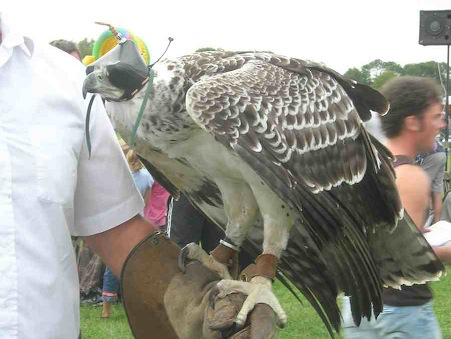
Birds were not the only creatures to make an appearance at the show, as we also invited many other animal organizations from around the county to join us. Of notable interest here were the Suffolk Punches of the Horkesley Park Heritage and Conservation Centre - true symbols of our East Anglian heritage.

We also had several art and craft stands at the event and I have to say that the standard of artistic talent was outstanding. One artist that really stood out for me was Chris Winch, whose equine and wildlife studies in both mixed media and water colours were breathtaking.

There was even a little taste of falconry history with a significant World War II connection on view. This took the form of a beautiful bronze art-deco falcon which is owned by one of the exhibitors, the British Falconers Club. Thanks to Dave Aldred of the BFC, I discovered the statuette was created by an artist named Wilhelm Krieger (1877-1945) who lived in Herrching, Germany and trained at the Royal College of Art in Munich. The piece, which had a beautiful simplicity of line, was originally created as an honorary prize for the International Hunting Exhibition held in Berlin in 1937 and won by Gilbert Blaine and Jack Mavrogordato - the latter, something of a falconry legend.
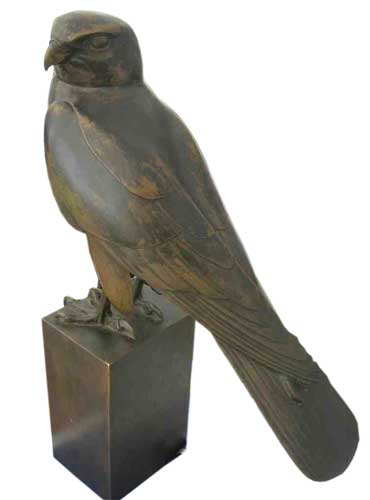
However, the prize was presented by one Hermann Goering and consequently is often referred to as 'the Goering Bronze'. Due to this connection it was not considered ‘politically correct’ to have the piece on public display and has spent many years hidden away in cupboards, under beds and or many years was used rather indignantly as a doorstop! It's good that this beautiful piece has re-surfaced and is able to regain some of the respect its rich heritage truly deserves.
We hope that everyone who attended the Fair enjoyed it and we look forward seeing to seeing you again at the next September.
Minerva's Eye
Here at the Suffolk Owl Sanctuary we get many requests to visit schools and other worthy organisations to give talks, lectures and the occasional flying demonstration.
These events are something we love to do, as it gives us the opportunity to share our beautiful birds with the community at large and at the same time educate, entertain and hopefully promote the centre in regard of the rehabilitation and re-release work with the wild injured birds of prey that are brought in to S.O.S. every year.
However, every now and then these requests take an unusual turn and that was the case when we were recently asked to make a ‘surprise’ appearance at a local Ipswich school.
The school in question was Ipswich High School for Girls, which is currently celebrating two very significant anniversaries - the first being its being established for 130 years; and the second, it being the 15th anniversary of the schools move to its present 84 acre site, located just outside the town in the grounds of Woolverstone Hall.

The impressive facade of Ipswich High School for Girls at Woolverstone
In recognition, the school decided it was time to give their existing logo a face-lift, and they chose an owl as the inspiration for the new graphic because the school is a member of the Girls’ Day School Trust, whose logo is the Roman goddess Minerva.

Ready for action - the goddess Minerva is born dressed ready for battle - and with an Owl in tow
For those unfamiliar with Roman mythology, Minerva was the goddess famed for having an owl as a companion. The Romans, adapting the original Greek myths, believed that Minerva was born in a rather usual way - the story goes that when the god Jupiter once suffered a horrible headache, his compatriot Vulcan opened up his head and out came the goddess Minerva. She was fully grown; dressed in armor, a long trailing robe, a helmet, a shield and a spear; & was accompanied by an owl. As Jupiter's daughter, Minerva was thus regarded as the virgin goddess of warriors, poetry, medicine, wisdom, commerce, crafts, and the inventor of music. As Minerva Medica, she was also the goddess of medicine and doctors.
Therefore the choice of this particular goddess was totally in sync with the current hilosophy of Ipswich High School for Girls, which encourages its students to pursue many of the vocations and pastimes listed above. And as Minerva’s owl was also thought to be very wise, benefiting symbiotically from the goddess’ own great wisdom, an owl provided a fitting symbol from which to develop a new logo. As possibly the most widely known of all owl attributes is their incredibly good eyesight, the school focussed on this as the basis of the new graphic.
And that was where we came in. The logo was developed earlier in the year, ready for the new school term to beginning in the Autumn, and we were asked along to the school to help launch it, together with the help of our Indian Eagle Owl, Baloo.
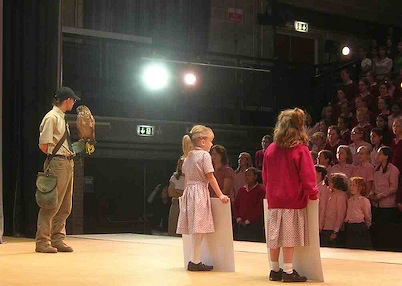
The new logo is presented to the School at a special ceremony
Elaine Purves, head of the school, said, “We are delighted with the new-look logo. It is fresh, bright and meaningful. At first glance it could be a flower or a sunburst, both images which reflect the energy, growth and optimism which permeate the school: to further understand the connection of our logo with Minerva’s Owl is also to appreciate the link with our GDST heritage and its commitment to the dynamic education of girls.”

Baloo and some of the students pose for the local press
Speaking for S.O.S., we're delighted that in today’s modern society, owls still have a very significant part to play in the education of young people, and that these fascinating creatures are still as important and inspiring today as they have been throughout history. We hope that the school will continue to go from strength to strength under its new logo, and we were delighted to help with its launch.
Tiaga, Tiaga Burning Bright
Here at the Suffolk Owl Sanctuary we like to bring you regular updates of all our new arrivals, and if you have been a regular reader of our SOS Diary pages then you will already know that we have been planning to acquire a Great Grey Owl for quite some time! Well, I am happy to report that the day finally arrived recently and our new acquisition is settling in well to his (or her) new surroundings.

Wide eyed & restless - our Tiaiga will be airborne soon
We decided to call our new addition TIAGA (pronounced Tia’ga), as the name refers to the habitat or biome where this owl species can be found in the wild. As the world's largest terrestrial biome, it's a habitat characterised by the coniferous forests which cover inland areas of Alaska, Canada, northern Scandinavia, Russia, the extreme northern continental United States, Kazakhstan and Japan.

Typical Tiaga Forest, home of the Great Grey Owl
The Great Grey Owl (or Lapland Owl, latin name Strix nebulosa) is a very large owl which is distributed widely across the tree lanes of the Northern Hemisphere. Adults Great Greys classically have a big, rounded head with a grey face and yellow eyes with darker circles around them. The under-parts are light with dark streaks; the upper parts are grey with pale bars. This particular species of owl does not have the distinctive ear tufts we associate with many of the larger owls, but makes up for it by having the largest "facial disc" of any owl species.
In terms of length, the Great Grey Owl rivals the Eurasian Eagle Owl and the Blakiston’s Fish Owl in the title for "world's largest owl", but much of its size is deceptive, since this species' fluffy feathers, long tail and large head obscure a body lighter than most other large owls. The length may range from 61 to 84 cm (24 to 33 inches) with a wingspan which can exceed 152 cm (60 inches).

An adult Great Grey - TIAGA should look like fairly soon. (Picture courtesy Linda Wright)
Great Greys breed in North America from Lake Superior to the Pacific coast and Alaska, and from Scandinavia across the reaches of northern Asia. Their breeding habitat is generally near the open areas of meadows or bogs in the dense coniferous forests of the Tiaga. They do not build nests, so typically use nests previously used by other large birds or raptors or nest in broken-top trees and cavities in large trees. The abundance of food in the area usually affects the number of eggs a female Great Grey lays, which is quite common in owl species. If food is scarce, they may travel a short distance to find more prey, though they do not migrate.
Great Grey Owls usually wait, listen and watch for prey and then swoop down on it; they also fly low through open areas in search of food. Their large facial disks and the asymmetrical placement of their ears assists them in locating prey, combining to make an excellent hearing system which enables them to locate & capture prey moving beneath the snow. Unlike the more versatile eagle and horned owls, Great Grey Owls reply almost fully upon small rodents, with voles being their most important food source. Juveniles may themselves fall prey to bears and are a favourite of Northern Goshawks, while adults may fall prey to the eagle owls and lynxes.

Our young Tiaga - fledged but still Fluffy
The harvesting of timber from the Great Grey Owl's habitat is perhaps the greatest threat to the species. Intensified timber management typically reduces the large-diameter trees, leaning trees & and dense canopy closures which they like to use for nesting & roosting, and although human-made structures have been utilised by these owls, the species is far more common in areas protected from logging. Livestock grazing in meadows also adversely affects Great Grey Owls, by reducing habitat for preferred prey species.
So it is vitally important that healthy stocks of this species are maintained in captivity, in order to ensure that this variety of owl doesn’t one day go the way of the dodo. TIAGA is doing very well at his new home; he hasn’t begun his full training yet, but we will of course, give you updates of his progress as time goes on. We are sure that he will develop into a firm favourite here at SOS and if you wish to see TIAGA for yourself, please pay us a visit soon.

This young Red Squirrel has its characteristic bushy tail but its distinctive ear-tufts have yet to grow.
Red Alert - Tufty's Back!
For many months now we have been promising the arrival of some new Red Squirrels here at SOS. Well, it has been a very, very long wait... but at long last I am happy to report that they have finally arrived.
A pair of young males arrived a week ago and have now settled happily into their new surroundings. They are here as the foundation of our attempt to re-build our now sadly-depleted colony, which has been gradually shrinking over recent years due to the natural deaths of our original stocks, of whom only one ageing female remains.
The enclosure of the new arrivals - located within our “Woodland Walk” here at SOS - is purpose-built for these acrobatic individuals and I must say it has been a real treat to watch them scampering around at lightening speed as they investigate and explore their new home.

The Red Squirrel enclosure at S.O.S. - purpose-built for leafy acrobatics!
The picture at the top of the page shows one of the youngsters, which you can identify as immature because he is missing the distinctive ‘ear-tufts’ you normally associate with Red Squirrels (tufts which, incidentally, are completely absent from their less-popular grey cousins). The ear-tufts will appear in time, and when they do we will of course post you a picture of them - assuming, of course, that I am able to take a clear picture them.
Photographing these lively scamps has proved a task much easier said than done, as I have discovered over the last week! Thankfully Andrew Farrow (a fellow colleague here at SOS) helped me out and managed to secure the shots - either he has a natural flair for wildlife photography or simply just has more patience than I do - I’m opting for the latter!

Andrew Farrow accomplished the difficult task of photographing one of our lively new housemates!
Why do we have Red Squirrels here at SOS? Well, historically & conservationally they are a very interesting species and they also act as a natural counterpoint to the raptor population here at Stonham.
Red Squirrels (by nature) are very timid, tree-dwelling mammals that live at low densities within the UK and so are seldom seen. The most recent estimates of red squirrel population were compiled by Harris in 1995, when they estimated approximately 30,000 in England, 10,000 in Wales and 121,000 in Scotland, representing 70-75% of the GB population.
However, more recent population estimates are significantly lower, especially for Wales. The population in England is very fragmented, with isolated populations on the islands within Poole Harbour, on the Isle of Wight, and in near to us in East Anglia in Thetford Forest (and here sitings are so rare it is thought the population may have disappeared now). So we feel very privileged to have these wonderful creatures here at SOS, potentially the only Red Squirrels in the region.
Historically, Red Squirrel in the UK have had a chequered career. it is thought they made their way to the British Isles from Europe at the end of the last ice age, approximately 10,000 years ago. Records indicate a large population established by the 16th Century, though they were subject to population fluxes, principally because of loss of woodland. At one point Red Squirrels were reported as extinct in some parts of Scotland following deforestation, but the widespread planting of conifers and introductions of red squirrels from England and possibly Scandinavia early in the 19th century resulted in increasing populations by the 1900's.
However, in 1903 the Highland Squirrel Club was established to control Red Squirrels in Scotland because they were causing severe damage to trees by bark-stripping: over 82,000 animals were culled in the 20 years following. Generally, populations throughout the British Isles declined also.
But man is not the only enemy of the Red Squirrel. The Grey Squirrel was introduced in the UK at about 30 different sites between 1876 and the late 1930's, and as is generally known, contributed greatly to the continued decline of Red Squirrel populations to the extent they have replaced them throughout much of their former range. (It is thought that once Grey Squirrels arrive in a woodland populated by Red Squirrels, the two species can co-exist for about 20 years before Reds disappear from the site.)
Sadly, today throughout the whole of the UK, the Red Squirrel is still under threat from long term habitat loss, potential Grey squirrel incursion and disease transmission: it is predicted that their numbers will continue to decline, at least in mainland UK, without specific habitat management.
So as we, mankind, have had a direct impact on the squirrels decline, it seems only right, that we should try to restore the natural balance wherever possible. From our previous colony we were able to donate progeny to the valuable release programmes that have been taking place in Wales, and our plan is to develop the new stocks so that we can make further contributions to controlled release programmes back to the wild.
Meanwhile, why not pay our new Red Squirrels a visit? We look forward to seeing you!
Pirates of the Skies
Over the last few months we have had many adventures here at SOS as part of our new ‘Activity Days’ programme for children. The latest took the form of a Pirates Day, created to coincide with the latest “Pirates of the Caribbean” movie which went on general release in the UK in May.
It proved to be a very popular day with the children who appeared captivated and stimulated by the theme and eager to learn more.
You may be thinking, “What possible connection could there be between Pirates and Birds of Prey?”
Well, the answer is more simple and straightforward than it seems! “Piracy” is a technique that several raptor species resort to in order to obtain a free meal. It may not be fair, but in the natural world it is a much easier and more “energy efficient” option to steal someone else's meal rather than go to the trouble of finding your own.
In order to understand this concept in simple terms, you could say that the raptors we studied, were infact 'pirates of the sky.'
The dictionary definition of the word ‘pirate’ refers to human beings who attack and rob other ships at sea, just like ‘Captain Jack Sparrow’ of POTC fame. The raptors we looked at, do a similar thing in the air - they attack and rob other birds of their food!
There are several raptor species around the world who employ this technique but we decided to focus on some closer to home, those that are located in the UK. This we were able to do with the help of a man called Brian McFarlane and his collection of amazing photographs. (Brian has been a great asset to SOS over the years, taking many of the photos that we use in our publicity material - and I would like to say a personal thank you to him for allowing me to use his photographs for educational purposes).
Thanks to Brian, I was able to show the children a series of nine photographs taken over a period of just five seconds, showing a wild Kestrel stealing (or should I say pirating) a meal from a Barn Owl. A truly remarkable achievement to catch this incredible moment on film.

After that, it was time for the gang of youngsters at Stonham to get down to the real business of becoming a pirate for a day! In order to do this properly we first had to look the part, and this required the making of pirate hats, which we did with the aid of a few old newspapers.
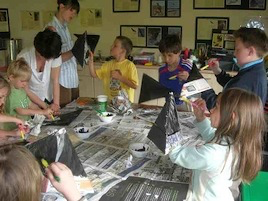

Once our hats were in place it was then time to make treasure maps, because without the all important map, how would a Pirate ever find the buried treasure? We had lots of fun making them, and to make it more interesting we even used old fashioned quill pens (feathers dipped in ink) to design them. We were lucky enough to have children of several different nationalities attend our Pirates day, so we also made maps in French and Polish as well as English.


So, with pirate hats, treasure maps and eye patches at the ready it was time to search for Captain Flintlock's Treasure, (a notorious pirate famed for terrorizing the Suffolk Coast). Well, actually it wasn’t his treasure to begin with, but he was certainly responsible for its theft!
As a Pirate sailing the coastal waters of East Anglia, there was only one treasure that Captain Flintlock was seriously interested in - and that was the famous Anglo Saxon treasure buried in a long-ship at Sutton Hoo, near Woodbridge. (For more details of the Sutton Hoo find go to http://en.wikipedia.org/wiki/Sutton_Hoo).

Being named after two of our favourite falcons here at SOS (Flint & Lock), it seems that this particular Salty-Sea Captain had a liking for treasure with a bird of prey theme, especially if it contained beautiful red garnets and was made of ancient 7th century gold. (See photo at the top of this story). Somehow (and we don’t know exactly how) Captain Flintlock, had managed to steal a single piece of this fabulous treasure and had hidden it away in a treasure chest secretly located somewhere within the grounds of SOS.
So this became our young adventurers last mission of the day! To use all their skill and understanding of Birds of Prey to solve Captain Flintlock’s Avian riddles and find the stolen treasure!
You can see just how difficult their mission was when you read just one of Captain Flintlock’s riddles.
Captain flintlock’s Treasure Hunt
If you want my booty – you first must go
Up the rigging with a Yo, Ho, Ho!
Along the ladder and down the other side
Beside the maze is where I reside
Inside out and upside down
The wheels on the bus go round and round
If you look very closely – then maybe you’ll see
That inside one of these two
Lies clue number three!
Well, much fun was had by all as the day continued and our “Pirates of the Skies” day was especially so, and for many of the children who have previously attended our Activity Days, they thought that it was the best adventure yet!

So if YOU would like to attend any of our free activity days then click here to find out about the whole series, or contact us directly to reserve a place in advance - but please hurry because as numbers are restricted to 16 per day on a first-come, first-served basis. We look forward to seeing you!
Chipmunkery Madness
For the first time in along time, some of the cutest new arrivals here at SOS don’t happen to be baby Owls!
Some friends of an SOS staff member had a private chipmunk colony at home whose numbers had increased to the point where the colony needed to be split in order to maintain a healthy population. So the decision was made and we agreed to take in these cute little critters, which meant that we had to create a new enclosure for them virtually overnight!

We decided that the best thing to do would be to customize an existing aviary located beside the Flying Ground, built earlier this year by our Head Falconer, Andy Hulme.
Originally, the new double aviary was to house a pair of Little Owls, and next door to them, a pair of Burrowing Owls. However as with many bird and animal centres, the collections are constantly evolving, changing and growing - meaning enclosure space keeps being re-defined and re-utilized. And, as everything else at SOS gets recycled and re-used to comply with our passion for conservation and the environment, that is exactly the way it should be.

So what is a Chipmunk and where do they originate? Well, a Chipmunk is a type of ground squirrel, a small striped burrowing rodent which is very fast and continually active. They love to jump and climb and are amazing escape artists - something which we learnt to our cost as despite our attention to security, a couple managed to escape within 48 hours of joining us, though thankfully all twelve of our furry new friends are now well and truly accounted for!
There are many species of Chipmunks around the globe, the most common being within the genus Eutmias. These originate from the coniferous forests of Northern and Western America, Canada, Mexico, Mongolia, Siberia, Korea and China. Chipmunks in the genus Tamias are found in the deciduous forest areas within Eastern Canada and North America.
The latter species of Chipmunk are the larger of the two, with a head-to-tail length of between 20-35cms, whereas the European and Asian Chipmunk are smaller. Due to the size of the new SOS chipmunk crew, we are convinced that we now have a coloney of Europeans on our hands!

Although they are commonly depicted with their paws up to the mouth,eating peanuts, or more famously their cheeks bulging out on either side, chipmunks eat a much more diverse range of foods than just nuts. Their omnivorous diet consists of grain, nuts, birds' eggs, fungi, worms and insects. Come autumn, many species of chipmunk begin to stockpile these goods in their burrows, for winter, whilst other chipmunk species make multiple small caches of food. These two kinds of behaviour are called larder hoarding and scatter hoarding. Larder hoarders usually live in their nests until spring.
These small squirrels fulfill several important functions within forest ecosystems. Their activities with regards to harvesting and hoarding tree seeds play a crucial role in seedling establishment. They also consume many different kinds of fungi, including those involved in symbiotic associations with trees, and are also an important vector for dispersal of fungi spores.
In the wild chipmunks are very opportunistic predators and infact they themselves play an important role in the food chain as prey for other predatory mammals and birds. One raptor species with aparticular taste for chipmunks is the Great Grey Owl, which shares the chipmunks North American home.

Later this year we will be adding a Great Grey Owl to our collection here at Stonham. (We will of course let you know when he or she arrives). But in the meantime, why not pay us a visit and sample some North American Ecology for yourselves, as our stripy little friends would love to meet you!

Suffolk at The Norfolk
Last Wednesday 27th and Thursday 28th June, the Suffolk Owl Sanctuary was represented at the Royal Norfolk Show. (The second major "outshow" on this year's calendar - see our earlier blog from the Suffolk Show).
The largest two-day agricultural show in the country the Norfolk Show was granted the privilege of the Royal prefix in 1907 by Edward VII, the royal connection having started in 1872 while he was Prince of Wales and graciously accepted the presidency of the Norfolk Agricultural Association.

The weather was considerably kinder than it had been for the Suffolk Show and the Suffolk Owl Sanctuary, together with another local chairty - the Raptor Trust - was able to spread the word about owl and bird of prey conservation to a wider and enthusiastic audience which included a huge number of children taking part in the Schools Trail. Four flying demonstrations (two on each day) were also enjoyed by the crowds.

If you'd like to see us in action out and about then check out the events section on the website but we are next at the "Green Living Day" in Holywells Park, Ipswich on Saturday 14th July.

If you went down to the woods that day..
Last weekend saw us launch a brand new initiative here at SOS - our very first 'Wildlife Weekend', held in a bid to encourage our visitors to think a little bit more about our planet and the impact we have on it, with specific regard to the flora and fauna of the region.
As it turned out we couldn't have planned our event to take place at a more appropriate time, with environmental issues hitting the headlines just about everywhere we looked! The week preceding our event saw the BBC hold its 'Saving Planet Earth' campaign, which raised over £1,25m for a new charity called the BBC Wildlife Fund. For more information on the projects it has pledged to sponsor, go to www.bbc.co.uk/savingplanetearth
The Saturday of our ‘do’ was also the day of the 'Live Earth' event - a 24-hour, 7-continent series of concerts that brought together more than 100 top-line artists which attracted a global audience of around 2 billion people for its message about solving the current climate crisis of global warming! This event marked the beginning of a multi-year campaign led by various international organisations to persuade individuals, corporations and governments to take action to solve these problems. If you would like to know more about the Live Earth campaign go to www.liveearth.org
Our own initiative was on a rather more reduced scale, though (we felt) equally as significant in its own way because as we too want people to realise that if you seriously want to conserve wildlife and the environment, then you really need look no further than your own back yard!
For our event we gathered together as many different wildlife, conservation and rehabilitation groups from across the region as possible to illustrate the incredible diversity of wildlife there is to be seen, studied and enjoyed right here on our East Anglian doorstep.
Organisations such as the R.S.P.B, Ipswich Wildlife Care & Rescue, and The Hawk & Owl Trust were all represented at the event, where we showed many aspects of countryside management from badgers to butterflies, hedgehogs to red squirrels, bats to dragonflies, and songbirds to amphibians.


In regard to the latter, we held some popular pond dipping sessions in our Woodland Walk to show young visitors how easy it is to encourage wildlife into your own garden! These pond-dipping sessions were great fun and also allowed many of the adults present to relive childhood memories with the aid of jam-jars & nets a-plenty.
The pod dipping also gave us the opportunity to highlight the current plight of frogs, which are in decline globally. As indicators of environmental change due to the fact that the skin through which they breath is incredibly sensitive to ultra-violet radiation, they are suffering on increasing scales due to the depletion of the ozone layer. If you would like to know the facts behind the frog's plight, go to www.actionbioscience.org/biodiversity/howse.html


Finally, I would like to thank the SOS Volunteer Team who played a vital role in support on the day, as usual making an incredibly selfless and essential contribution to the running events at the centre. Thanks guys - much appreciated!

Vertically Challenged
Those of you that regularly read these diary pages will know that we like to bring you regular up-dates of the new arrivals at S.O.S. So far this year’s breeding programme has been quite successful and our proudest achievement to date was the arrival of our first parent-reared Boobook Owlet. (For more information, click here to read our Boobook Baby story.)
But every now and then we sometimes wish to add birds to the collection which we are unable to breed ourselves, simply because we have no parent birds of the relevant species. So, if you like puzzles, try to guess which terrifying new species of raptor had come to join us at Stonham!
Here are some clues. Firstly, this type of owl quite literally couldn’t get any smaller - for which reason we are calling the new arrivals Titch & Tiny. Secondly, they’re members of the Little Owl family. And thirdly - the best clue I can give you - is that these little fella’s are the only species of owl known to nest underground.
The answer we’re looking for is that our new arrivals - aptly named Titch & Tiny - are Burrowing Owls, or Athene Cunicularia for the Latin scholars amongst you. (For non-Latin scholars, you can always tell a Burrowing Owl because they carry little shovels around with them! Boom boom!)
To be accurate, only five-week-old Titch has arrived at S.O.S. so far: Tiny will be joining us shortly. For the record meanwhile, Titch currently stands approximately 5 inches tall and as a full grown adult could potentially reach the dizzying heights of, oh, 8.5 inches or more (which is where the ‘vertically challenged’ bit comes in).
Culture Vultures
Our program of new Adventure Activity Days for children took place last Saturday. The day - entitled “Egyptian Mummy Madness” - has been devised to teach youngsters all about falconry and birds of prey within an ANCIENT EGYPTIAN context.
Clearly, raptors played a very significant role within the culture of Ancient Egypt, especially vultures & falcons - birds native to the region with which the Egyptians would have been familiar with on a day-to-day basis. With this in mind our group of young enthusiasts set out to examine just how important these birds were in relation to the religious and cultural beliefs of the anccient dynesties, beginning with the Legend of Horus, the famous Egyptian god with a man’s body and the head of a falcon.
Horus was the God of the Sky, bearing a name which literally translates as “The One Far Above”. I can’t think of a creature more appropriate than the Falcon to embody this sentiment and clearly the ancient Egyptians thought so too - falcons are capable of flying higher than most other birds. On this basis it was believed Horus was physically able to get closer to the most important and powerful of all the Egyptian deities, Ra, the Sun God - and therefore became one of the most important Egyptian spirits.
Horus was usually depicted as either a man with a falcon’s head or as a pure falcon, and as a consequence, Egyptians also firmly believed that their Pharaoh of the day (a divine king) was the earthly incarnation of the God of The Sky.
The ancient Egyptians had many different beliefs about Horus, the most common being that he was the son of Isis and Osiris, the Gods of Fertility. Legend has it that after Osiris was murdered by his brother Seth, Horus fought with Seth (his uncle) for the throne of Egypt. During the course of their 80-year battle, Horus lost an eye but the Gods later collectively judged Horus to be the winner and restored his sight. As a mark of respect and remembrance, Horus then offered the eye to the Gods in memory of his late father, Osiris.
After the battle, Horus was chosen to be the ruler of the world of the living, so becoming Pharaoh and vice-versa. From that moment, the “Eye of Horus”, otherwise known as Udjat, was considered a very powerful symbol of life and protection in Ancient Egypt and is represented in iconology as the combination of a human eye and the cheek markings of a falcon.
In order for our young adventurers to see the close resemblance between the Udjat and these avian markings, we took a close look at two of the falcon species at S.O.S. with which the ancient Egyptians would have been very familiar. So Flint, our Lanner Falcon and Nell, our Saker Falcon stepped up for inspection of the dark streaks of feathers just beneath their eyes, called ‘Malar’ stripes. Rather like athletes putting blacking under their eyes to prevent glare (cricketers and American Footballers spring to mind), the biological theory is that these stripes prevent glare when flying directly towards the sun as the falcons prepare to ambush prey. The picture above shows a Lanner falcon with a red arrow marking the position of the Malar stripes.
As mentioned previously, Horus’ parents were called Osiris & Isis and here at S.O.S. we have a female Pharaoh’s Eagle Owl called - yes, you’ve guessed it - Isis. This species is also known as Savigny’s Eagle Owl or Desert Eagle Owl, the latter being particularly appropriate as it is found throughout North West Africa from Morocco to Egypt, across most of the Sahara, Sinai, Syria, Israel to Palestine and from Western Iraq to the East Arabian Peninsula - very dry stuff!
The Pharaoh's Eagle Owl inhabits the rockier desert regions within its range, particularly the gorges, cliffs and rocky mountain slopes which provide the bird with good hunting opportunities and suitable nest sites. It has also been said that these owls have been known to nest amongst Egypt's most famous (man-made) mountains, the Pyramids. I am afraid that I can neither confirm nor deny this fact, but nesting on a Pharaoh’s tomb would certainly explain how this bird got its more commonly used name!
All this led our Activity Adventure group on nicely to ancient Egyptian pictorial writing, or “hieroglyphics.” How so? you say! The answer is simple as the Owl is used in the hieroglyphic alphabet to represent the letter ‘M’. I say that the answer is simple, but in fact it took several noted Egyptologists many years to decipher the hidden meaning of the hieroglyphs, with the code eventually being cracked in 1822 by Jean-François Champollion using the now famous Rosetta Stone to help with translation.
Studying this amazing alphabet inspired us to use dough to fashion some traditional Egyptian writing tablets of our own, onto which we inscribed our names in true hieroglypgical fashion. This gave us the opportunity to take a look at Verdi’s operatic masterpiece AIDA, an Egyptian ‘soap’ on the grandest scale and for which a recent marketing campaign used hieroglyphics as part of its advertising campaign. Still in creative mood, our group then carved a copy of the Pharaohs Eagle Owl, inspired by a photograph I took in the British Museum. Meanwhile one of our older adventurers made a Falcon pectoral - a piece of funeral jewellery.
To round off this culturally stimulating day, we decided to have a look at the Egyptian Goddess Nekhbet, who was represented in the form of a vulture. There are several vultures native to the Middle East, but the two we chose to study were the Griffon and Egyptian vulture.
Due to her vulture form, Nekhbet was linked to the goddess Mut, the mother goddess and second wife of the ancient Egyptian god, Amen. Both Mut and Nekhbet were iconised as a particular type of vulture, the Griffon, usually associated with goddesses and royalty.
Due to vultures’ immense size, power and ability to soar high in the sky, they - like the falcons - were considered to be nearer to the Gods than mere mortals. Their wide wingspan was regarded as all-encompassing, providing both a gentle and protective covering to their infants whilst being forcefully capable of defending them. So as well as being famed for her maternal instinct, in common with many Egyptian protective deities Nekhbet also had a fierce side, too - she was linked to war and combat and in many war scenes she is depicted hovering above the Pharaoh, protecting him from his enemies.
All these qualities inspired the imagination of the Ancient Egyptians. They adopted the vulture as a powerful symbol of maternalism, and so Nekhbet was worshipped as the protector of the king and the common man, revered as the Goddess of childbirth and esteemed as the Goddess of the Sun and the Moon.
Due to her high ranking status, Nekhbet was also charged with holding the symbol of Eternity in her talons and in her honour, those on our Activity Adventure decided to re-create a piece of ancient Egyptian artwork based on many of the tomb paintings we had investigated as we uncovered her story.
We hope she would have approved and possibly afford us some protection as we travel through life to our next Activity Adventure Day, which is called PIRATES of the SKIES and takes place on the 14th July 2007 here at SOS. We hope to see you there! For more details, please follow this link.
Thunderbirds Are Go!
Our series of Adventure Activity Days for children continued here at SOS earlier this month and although entitled, “Thunderbirds ‘R’ Go!”, there wasn’t a Gerry Anderson-style marionette to be found anywhere!
The reason is that the birds in question related to a much older legend, that of the Thunderbird, the spiritual icon of many native cultures in the Americas long before Christopher Columbus arrived in 1492. However, it was Columbus who first referred to the peoples he found there as Indians, believing (incorrectly) that he had arrived in Asia, which the Spanish referred to as the ‘Indies’.
However, the Native American Indians were not a single race of people as many of the first Europeans thought. The incumbents were made up of many different tribes, each rich with its own individual cultural heritage, customs and traditions. But one particular myth appears to have bound all of these tribes together - the legend of the Thunderbird.
So why do we make a legend the subject for one of our popular activity days? The simple answer is that the “Thunderbird” was supposed to be a giant raptor, potentially the largest bird of prey that ever lived. It was reputed to have a wingspan equal to the length of two war canoes which, at sixty-three feet in length, gave a potential wingspan of 126 feet! The Thunderbird got its name because many of the Native American Indian tribes believed this bird caused fierce storms as it flew through the air, and that the noise we call ‘thunder’ was caused by the beating of those enormous wings!
Amongst other Thunderbird legends we uncovered are that they were invisible; were created by the Great Spirit to carry messages from one spirit to another; and had a hand in the creation of all the birds we have today. As author Richard L. Dieterle recounts:
“As the Thunderbirds traversed the heavens, they would occasionally lose a feather. From such feathers, the visible birds sprang into existence. From the large quill feathers of the Thunderbirds came the race of EAGLES; from other large feathers came the race of HAWKS and their kind; from small feathers came such birds as PARTRIDGES; from the down feathers came the small birds like ROBINS and PIGEONS; and from the mere fuzz of down feathers emerged the very smallest birds, such as the SPARROWS and the HUMMINGBIRDS! All birds therefore, are descended from the Thunderbirds.”
For this reason, Thunderbirds, Eagles and Feathers have become an integral part of Native American Indian Art, Culture & Custom.
We continued our day by having a look at some Thunderbird imagery to get a better idea of what we were talking about. A lot of associated pictures illustrate a large raptor with a ‘comb’ on its head. We found the only living raptor from the America’s that matches this description is the male Andean Condor, which has a fleshy or cartilaginous comb on its head and a wingspan of usually between nine and twelve feet.
Then we considered other aspects of the legend - or is it? Even as recently as 2002, people in Alaska reported sightings of an enormous raptor with a large wingspan. Sceptics stated that a bird of this size they saw could not have flown, but this is not completely outside the realms of possibility - we discovered that the prehistoric vulture-like Teratornis Incredibilis had a wingspan of around 16-24 feet and is widely believed to have been capable of flight.
And while we were on the subject, our ‘tribe’ verified that investigators think that Thunderbirds were associated with storms because they followed the drafts to stay in flight, not unlike a modern eagle the rides the air currents found in the mountains. Noted crypto-zoologist John Keel claims to have mapped several Thunderbird sightings and found that they correspond chronologically and geographically with storms moving across the United States. So perhaps there could be some truth in the legend after all!
Back down to earth, we decided to round off the activity day by creating some Indian feather-work of our own, inspired by all the wonderful things we had studied. We decided to try a spot of FEATHER WRAPPING and making DREAM-CATCHERS.
Feather wrapping and cutting was originally a method of communicating with onlookers; worn in the hair or as jewellery, the decoration would indicate a person’s tribe, clan or status. Native American tribes variously used to hang dream-catchers over the heads of sleeping children to filter dreams: the good dreams passed through the centre of the net into the mind of the sleeping person, whilst bad dreams got trapped in the web and perished in the light of the dawn.
So, all-in-all, a fascinating day with lots to discover and plenty to do. If you would like to take part in our next THUNDERBIRD ADVENTURE DAY watch this website for details of our schedule for 2008.