

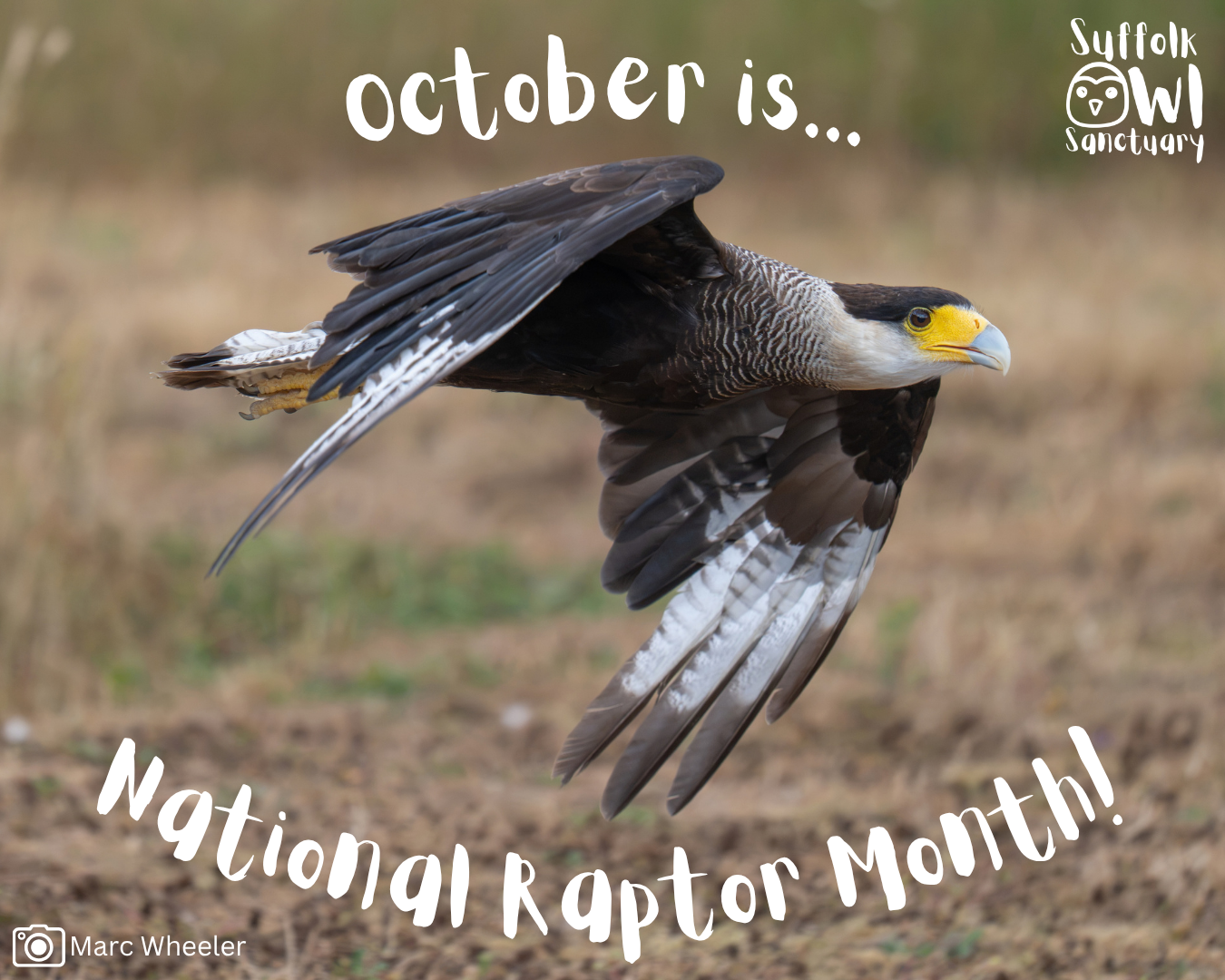
National Raptor Month is a wonderful opportunity to celebrate some of the most fascinating birds in the world. From soaring eagles and graceful kites to powerful buzzards, secretive owls and incredibly fast falcons, raptors come in an extraordinary variety of shapes and sizes. Yet beneath their differences, they share a collection of remarkable features that make them perfectly adapted to life as predators.
But what exactly makes a raptor a raptor?
Powerful Talons
One of the most recognisable features of a raptor is its feet. Raptors have strong, curved talons designed for catching, gripping and, in many species, killing their prey.
Unlike birds that primarily use their feet for walking or perching, raptors use their feet as highly specialised hunting tools. Their toes can exert tremendous pressure, allowing them to seize prey securely, even when flying at speed. An eagle, for example, can use its powerful talons to carry surprisingly large prey, while a kestrel's feet are perfectly suited to catching smaller animals.
The shape and size of a raptor's talons vary according to what it hunts. This is a wonderful example of how evolution has shaped different raptors for different lifestyles.
A Hooked Beak
Look closely at a raptor's face and you'll notice another important feature: its beak.
Raptors have strong, sharply hooked beaks adapted for tearing food. Rather than chewing their prey, they use the powerful cutting edge of the beak to pull apart flesh.
There is plenty of variation between species. A large eagle has a substantial, powerful beak, while a smaller falcon has a more delicate-looking but highly effective one. Some falcons even have a distinctive notch in the upper bill, known as a tomial tooth, which helps them dispatch prey.
The hooked beak and powerful talons work together as an impressive pair of tools, allowing raptors to handle their food efficiently.
Exceptional Eyesight
If there is one sense that truly defines many raptors, it is sight.
Raptors have exceptionally well-developed vision, allowing them to spot prey from considerable distances. Some species have eyes that are proportionally very large, giving them an impressive ability to detect movement and detail.
Their vision isn't simply about seeing farther than we can. Many raptors are also extremely good at judging distance and movement, which is essential when hunting prey from the air.
A kestrel can hover while scanning the ground below, while an eagle can search enormous areas of landscape from high above. Falcons, meanwhile, combine excellent vision with incredible speed when pursuing prey through the air.
For a predator, being able to see the right target at the right moment can make all the difference.
Wings Built for Hunting
Raptor wings come in many different shapes, and those shapes tell us a lot about how a bird lives.
Broad-winged species such as buzzards and eagles are superb soarers. Their large wings allow them to take advantage of rising air currents, enabling them to travel long distances while using relatively little energy.
Other raptors have very different wings. Falcons tend to have long, pointed wings that help them achieve remarkable speed and manoeuvrability. This makes them particularly effective at pursuing prey through open air.
Then there are species such as sparrowhawks, whose shorter, broader wings and long tails help them manoeuvre rapidly through woodland and around obstacles.
There is no single 'raptor wing'. Instead, each species has a wing shape suited to its particular hunting strategy.
Sharp Eyes and Sensitive Ears
Although eyesight is enormously important, some raptors also have highly specialised hearing.
Owls are perhaps the most famous example. Their facial discs help collect and direct sound towards their ears, allowing them to locate prey even in very low light. Some owl species can pinpoint sounds with extraordinary accuracy.
Their ability to hunt using sound demonstrates that being a raptor isn't simply about having sharp eyesight. Raptors have evolved different sensory abilities to suit their environments and hunting methods.
A golden eagle searching open countryside, a peregrine pursuing a bird in flight and a barn owl hunting a vole in darkness are all using different combinations of senses to solve the same basic problem: finding food.
A Life Built Around Predation
At the heart of what makes a raptor a raptor is its lifestyle.
Raptors are birds of prey. They have evolved physical and behavioural adaptations that allow them to hunt and consume other animals. Their diet can include mammals, birds, reptiles, amphibians, fish and insects, depending on the species.
But even here, there is enormous diversity.
A fish-eating osprey has feet and talons adapted for catching slippery fish. A peregrine falcon specialises in hunting birds, often catching them in spectacular aerial pursuits. A red kite is an opportunistic feeder that can take a variety of food, including carrion.
Some raptors are active hunters, while others make extensive use of scavenging. Their diets and hunting strategies may differ dramatically, but their bodies are all adapted to obtaining food in ways that make them effective predators.
The Ultimate Adaptations
Perhaps the most fascinating thing about raptors is that there isn't one single feature that makes them what they are.
It is the combination.
Powerful feet allow them to seize prey. Hooked beaks allow them to tear food apart. Excellent eyesight helps them locate targets. Specialised wings allow them to soar, hover, dive or manoeuvre. Acute senses help them hunt in different environments.
Together, these adaptations create some of nature's most accomplished aerial predators.
And that is exactly what makes National Raptor Month such a wonderful opportunity to look more closely at these birds. A soaring buzzard may seem very different from a darting peregrine or a silent barn owl, but each one represents a different solution to the same evolutionary challenge: how to survive as a predator.
Why Raptors Matter
Raptors aren't just impressive animals to watch. They also play important roles within ecosystems.
As predators and, in some cases, scavengers, they form part of food webs and interact with populations of other animals. Their presence can also tell us something about the health of the habitats they depend upon.
Protecting raptors therefore means protecting much more than individual birds. It can mean protecting nesting sites, hunting grounds, wetlands, woodland, farmland and other habitats that support entire communities of wildlife.
📝 Conservation Officer Amber Hanys
