

Become a Pellet Detective by studying
Barn Owl Pellets
We’re pleased to say we’re BACK IN STOCK of the popular Barn Owl Pellets we sell for dissection - each one a fascinating exploration that engages young minds on a voyage of natural history discovery.
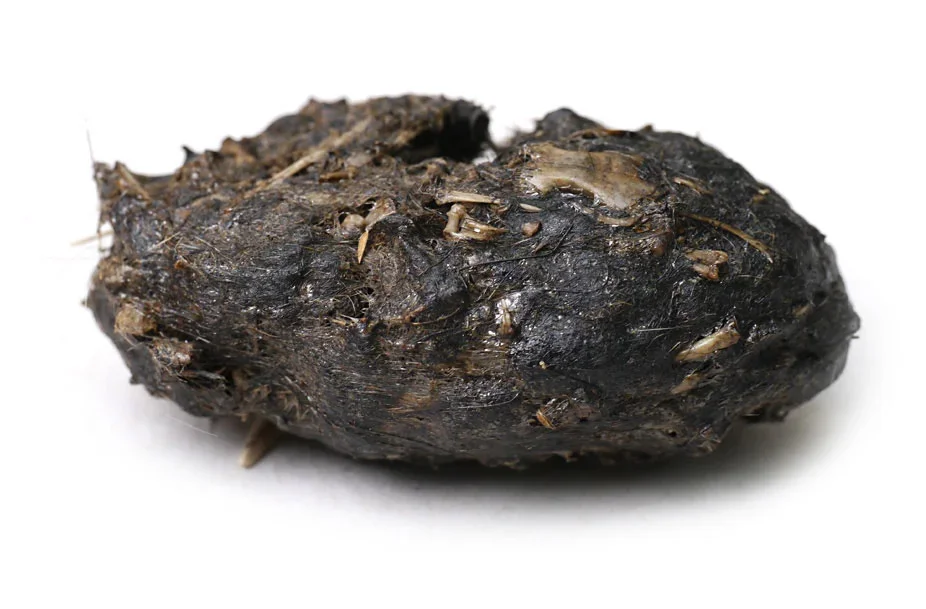
Each pellet order will come with a complimentary Bone Identification Chart and Worksheet to help you get the most from this engaging experience together with a copy of the “Stonham Screecher” Newsletter & Quiz Sheet. The pellets cost £4.00 each. Tweezers are available separately at £0.25p each and extra work sheets at £0.15p each.
There is a £5 P&P charge for your complete order, irrespective of the number of pellets, leaflets or tweezers included. Please note we can only dispatch orders outside of the UK by prior arrangement - please email info@owlhelp.org.uk for a quotation stating your country and number of pellets required.
-
Owls are carnivores that eat animals such as birds, rodents, rabbits, frogs, and insects. Lacking teeth, they swallow prey whole or tear it into chunks with their beaks. Soft parts are digested in the gizzard, while indigestible material like bones, hair, and feathers is regurgitated as a soft, odourless pellet — not passed as droppings
-
Owls often sit at the top of their food chain and play a key ecological role. Studying Owl pellets offers valuable insights into their diet and habitat. The individual pellets are sterilised with heat to ensure they are safe at home or in the classroom. They are also sorted for quality and size to make sure that each pellet provides an interesting and educational experience. Each pellet is completely unique and they are not artificially filled or tampered with during their preparation.
-
Pellets can be dissected when they are dry, but are sometimes a little stubborn. Often it helps just to soak them for about half an hour beforehand and then pat them dry with paper towels.
Write your name and the date on a clean piece of card
Using the tweezers and a cocktail stick, tease the pellets apart
With the tweezers, carefully remove anything you find, clean it up and dry it on a paper towel
Match each item you remove with the Bone Identification Chart
Stick the items you have found on to your clean piece of card, carefully labelling each part as you do so. Remember to write the name of the prey on the card, once you are sure what it is - you may need more than one piece of card, if you think you have found more than one type of prey!
Teacher Notes for Pellet Detectives
Pellet dissection is a fascinating and informative science activity, which can prompt all sorts of discussion and investigation into varied aspects of nature, such as food chains and habitats. It can also lead to the exploration of much wider topics, including the conservation and care of local and global environments.
As with many such topics, the possibilities for expansion of the subject and the inclusion of other areas of the curriculum are boundless!
Key Stage 2 Objectives & Outcomes
The Objectives and Outcomes for this activity are taken from those given by OFQUAL (Primary and Secondary Legislation Standards Site for Science) and are only intended as a guide.
-
Unit 3A: Teeth and eating
Objectives - that different animals have different diets
Outcomes - identify different sorts of food eaten by the animals -
Unit 4B: Habitats
Section 3: Different animals in different habitats
Objectives - that different animals are found in different habitats; that animals are suited to the environment in which they are found
Outcomes - state that animals and plants are found in some places and not in others and explain -
Unit 5_6H: Enquiry in environmental and technological contexts
Section 2: Collecting and interpreting data
Objectives - to collect and record data appropriately; to look critically at data collected
Outcomes - collect and record data carefully -
Unit 6A: Interdependence and adaptation
Section 9: Animals and plants in a different habitat
Objectives - that different animals and plants are found in different habitats
Outcomes - name some animals and plants found in the habitat; identify features of animals and plants which make them suited to their habitat.